Wozep ecological programme
Wozep - the governmental ecological programme for offshore wind energy - aims to establish a deepening knowledge about the effects of offshore wind farms on birds, bats, marine mammals and their habitats. This know-how is indispensable when it comes to the large-scale development of offshore wind energy. For example, what will be its impact on vulnerable bird species? Is it possible to estimate what the effects will be on protected marine and coastal populations over a period of ten or twenty years? In order to build on this knowledge, longer-term research and monitoring is required. Wozep also carries out modelling of future scenarios whereby the construction and commissioning of wind farms in the North Sea is expected to expand on a much wider scale.
The knowledge acquired by Wozep is directly applied at the policy and implementation level, for example, in the KEC (the Framework for Assessing Ecological and Cumulative Effects) or in decisions taken regarding the exact location of offshore wind farms. This project is implemented by Rijkswaterstaat and commissioned by the Ministry of Economic Affairs and Climate Policy.
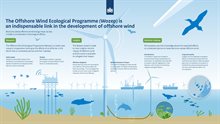
Wozep infographic
Wozep newsletter
After the publication of Wozep newsletter 4, it was decided that further newsletters are published in Dutch. You can find these newsletters and the subscription form on this page.
The development of this knowledge requires time. For that reason, Wozep has drawn up its planning and a road map in the form of a multi-annual programme. The latest version of this is embodied in the multi-annual-plan-programme-wozep-2024-2030 (pdf, 2.5 MB). Wozep is also an adaptive programme: it does not lose sight of the ongoing ecological problems in the North Sea and fine tunes the priorities in research accordingly in the form of an annual plan. The current version is the 2025-2026 annual plan [in Dutch only].
Wozep has identified six themes within the programme.


Wozep Data