
Offshore energy transition
The energy transition taking place in the Dutch sector of the North Sea is making a significant contribution to achieving the climate goals agreed on in Paris in 2015. The biggest share in this transition is being made by offshore wind energy. The current Offshore Wind Energy Roadmap aims to achieve a total of 21 gigawatts by around 2035. Other offshore sources of renewable energy, such as solar and hydrogen power, are also being developed.
In the 2015 Paris Climate Agreement, nations worldwide agreed that global warming should be kept to under 2 degrees Celsius compared to pre-industrial levels. In the Netherlands, this has been translated into a national Climate Agreement whose central aim is to reduce the emission of greenhouse gases by 49% compared to 1990.
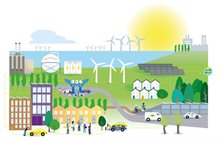
To achieve the central aim of the Dutch Climate Agreement, a number of measures need to be implemented. One of these is the energy transition: in other words, the changeover from energy generated by fossil fuels to electricity gained from renewable sources. The goal is for 70% of all electricity to be supplied from renewable sources by 2030. This will be achieved through the use of offshore and onshore wind turbines and from rooftop solar panels and solar parks.
Meanwhile, the demand for electricity continues to grow. Electric cars are increasing in number and industry is replacing oil and gas with clean electricity. Households are abandoning gas and will need additional electricity for heating and cooking. Not only that, as the availability of fossil fuels becomes scarcer, there is a desire to minimize levels of energy dependence on other countries. All this is creating a demand for alternative methods of energy supply.
Offshore wind energy
The generation of offshore energy in the North Sea can play a major role in attaining the goals set out in the Climate Agreement and in the transition to sustainable energy. At the moment, this renewable energy is being harnessed primarily from wind. Wind is a sustainable source of energy available at large scale out at sea: in terms of surface area, the North Sea is 1.5 times the size of the Netherlands. Additionally, the wind out at sea is stronger and more constant than that on land. This means that offshore wind turbines can generate electricity more efficiently than their onshore counterparts.
Emissions of greenhouse gases resulting from the generation of electricity from an offshore wind farm are 40 times less than those from a natural gas-fired power station in the Netherlands. This rises to 80 times when compared to a coal-fired power station. Greenhouse gas emissions involved in the manufacture, transport, maintenance and decommissioning of a wind turbine are a mere fraction of those greenhouse gas emissions which are saved during its operational lifespan.
Transitions in the North Sea
In addition to the energy transition, there are another two major transitions taking place in the North Sea: the nature transition and the food transition (see North Sea Programme 2022-2027 (pdf, 25 MB)).
These three transitions are all interrelated and sometimes, these may have competing demands for use of the ocean space. For that reason, a policy has been put in place which ensures a balance between the energy transition, nature conservation and the future expectations of the fishing industry, taking into consideration all users and stakeholders. For example, there are increased levels of shipping, offshore drilling for oil and gas, and areas set aside for military training and for sand extraction. The North Sea is one of the busiest seas, so competition for space is intense.
The agreements arrived at in respect of these transitions have been set down in the North Sea Agreement (pdf, 1.2 MB).
The North Sea Programme elaborates on these agreements. In this way, optimum use can be made of the limited space, whilst also focusing attention on a healthy and sustainable North Sea. All this has been visualized in spatial development plan: Structuurvisiekaart 2022-2027 (pdf, 4 MB).
Offshore energy transition - four principles
The offshore energy transition is founded on four key principles:
- Offshore wind energy
Offshore wind energy concerns the generation of electricity through the use of wind turbines on an offshore wind farm. The government decides on the offshore locations of these wind farms, demarcates the exact sites, draws up tenders for the construction and operation of the wind farms, and ensures compliance with the statutory regulations for each individual site. Businesses can compete for a permit by subscribing to a tender. Once a tender has been awarded, a business (or consortium) is responsible for the construction and operation of the wind farm.
- Other forms of renewable energy
As well as wind energy, we are also looking at alternative sources of renewable energy in the North Sea, such as hydrogen and solar energy (see also under Free Passage and Shared Use in this North Sea portal).
- Offshore grid
The energy generated offshore must be brought onshore from the wind farm so that it can be used by homes and businesses in the Netherlands. This will be done via a network of cables (electricity) and pipelines (hydrogen). The whole process, from researching possible landfall sites to the laying of cables, is referred to as ‘the offshore grid’.
- Offshore energy transmission - management tasks
Once the wind farms are in place and the energy is transferred onshore, the preparatory phase will be complete and the ‘management phase’ will commence. The wind farm will be managed by its owner, TenneT will be responsible for the cables, and the government will check to see if everything has been done in compliance with the permit issued. For example, Rijkswaterstaat will be responsible for monitoring the construction, operation and decommissioning of a wind farm (see Inspection and Enforcement).
Wind energy areas and Windfarms
Offshore wind farm Egmond aan Zee (OWEZ)
Hollandse Kust (zuid) Wind Farm Zone including Offshore Wind Farm Luchterduinen (LUD)
Hollandse Kust (noord) wind farm zone including Prinses Amalia Wind Farm (PAWF)
Hollandse Kust (west) wind farm zone
Ten noorden van de Waddeneilanden, including Gemini wind farms Buitengaats and ZeeEnergie