The future of maritime safety: the North Sea in 2050
What might the North Sea look like in 2050? And what would that mean for maritime safety in the future? A new study commissioned by the Directorate-General for Aviation and Maritime Affairs outlines several possible futures. These scenarios can help MOSWOZ provide a sound basis for future risk policy.
The study focuses on risks to maritime safety: the likelihood of incidents such as vessel collisions, vessels drifting into fixed structures, fires, explosions, sinkings or groundings.
Four possible future scenarios for 2050
The research report (in Dutch) describes four future scenarios, which differ considerably. In the scenario ‘Veiligste vaart’ (Safest course), for example, the North Sea remains relatively straightforward for shipping. Few new wind farms are built, there are few incidents and, if something does go wrong, the impact remains limited. The most concerning scenario is ‘Alle hens aan dek’ (All hands on deck). It depicts a North Sea that is almost fully developed, with extremely heavy traffic, frequent extreme weather and other pressures. In this scenario, incidents are highly likely and could have serious consequences for maritime safety.
Critical uncertainties will shape the future
The scenarios are based on developments that are uncertain but could have a major impact on maritime safety in the future. The report calls these developments ‘critical uncertainties’. For example, will the offshore wind targets be met, or will fewer wind farms be built than currently expected? That development alone would have a major impact on future risks. If all the planned wind farms are built, vessels will be more likely to collide with wind turbines. There will also be less space at sea, while cables and pipelines running to shore will leave fewer places for ships to anchor. In addition, service traffic involved in constructing and maintaining the wind farms will increase congestion.
Other critical uncertainties include the growth in shipping traffic, the frequency of extreme weather, the fuels used by vessels and the scale of the cyberattack threat.
‘This is a very important study. We are trying to assess what the future may look like so that we can be prepared for what could happen.’
Carien Droppers, maritime safety adviser
Prepared for what could happen
Carien Droppers, a maritime safety adviser with the MOSWOZ team, took part in the workshops to develop and assess the future scenarios. ‘This is a very important study,’ Droppers says. ‘We are trying to assess what the future may look like so that we can be prepared for what could happen.’ She compares the future scenarios to the climate scenarios produced by the Royal Netherlands Meteorological Institute (KNMI). ‘Each scenario has positive or negative consequences – in this case for maritime safety in the North Sea, including in and around offshore wind farms.’
Scenario thinking as a basis for future risk management
The study supports the development of risk management for the North Sea and follows up on the Dutch Safety Board's recommendation to use scenario thinking.
‘We will use the study within MOSWOZ as we develop the risk management process,’ Droppers explains. ‘To manage how risks to shipping in the North Sea evolve, you need more than knowledge of the present and the past. You also have to take the future into account.’
Ideally, Droppers would like MOSWOZ to monitor the critical uncertainties because they are so important to maritime safety. ‘That would allow you to make adjustments along the way. A particular development may also come to a halt, while another becomes more important to monitor. Perhaps some new fuels will barely be used in the future, while the automation of seagoing vessels advances faster than expected. We cannot predict the future, but we now have a better understanding of which developments are worth monitoring.’
The method behind the scenarios
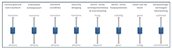
Two methods were used to develop realistic future scenarios: a morphological method and a two-axis method. The morphological method resembles a control panel for critical uncertainties. The two-axis matrix is a tool for grouping the many possible future scenarios in a coherent way.
The control panel and two-axis matrix were developed step by step with experts and stakeholders. First, an exploratory study examined how risks in the North Sea could develop and how they might be managed. This was followed by research into the critical uncertainties. During workshops, experts jointly developed and assessed the scenarios.