
MOSWOZ in Brussels: international knowledge exchange on maritime safety in the North Sea
Tuesday 2 June was an informative day for MOSWOZ in Brussels. Several team members, including Alma de Hoop, attended a meeting of the North Sea Shipping Group (NSSG) in the morning, followed by a workshop on maritime spatial planning in the North Sea in the afternoon. ‘Countries are now developing wind farms further out to sea, closer to the maritime boundaries with neighbouring countries. That calls for close coordination,’ says De Hoop.
The day was part of European Maritime Spatial Planning Week. Around 50 experts from different countries came together in Brussels for events including the annual NSSG meeting and the afternoon workshop.
Wind farms further offshore
In the North Sea Shipping Group (NSSG), North Sea countries exchange knowledge and experience on maritime safety in and around offshore wind farms. That morning, experts from several countries met to bring one another up to date. One of the topics was spatial planning in maritime border areas. ‘At first, wind farms were built close to the coast,’ De Hoop explains. ‘Countries are now developing wind farms further out to sea, closer to the maritime boundaries with neighbouring countries. That calls for close coordination. This is where the NSSG adds value.’
NSSG presentations
Vattenfall gave a presentation on the wind farm operator’s experience of the incident involving the tanker Eva Schulte (Netherlands Coastguard, in Dutch). In October 2025, the vessel became disabled and came dangerously close to the Hollandse Kust Zuid offshore wind farm. Other speakers presented a new safety model with a key innovation: it uses satellite data. This makes it possible to track vessels that are not visible through the Automatic Identification System (AIS) or radar.
Workshop on maritime spatial planning
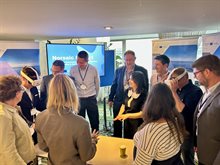
The afternoon workshop was organised by Shom, the French Hydrographic and Oceanographic Service. Experts from different countries were invited to discuss questions relating to maritime spatial planning in the North Sea. The workshop also aimed to generate insights and share knowledge on spatial planning. Working in groups, participants explored the problem of limited space in parts of the North Sea and considered ways to minimise its impact on maritime safety.
The Netherlands inspires other countries
Overall, the day was a success. De Hoop found it interesting to see that knowledge developed in the Netherlands is also being used abroad. ‘For example, the Americans used a Dutch framework for safe distances around offshore wind farms in one of their proposals. The framework sets out how much space vessels need at sea, for example to turn safely. Latvia has also shown interest in Dutch offshore wind guidelines.’