Collisions
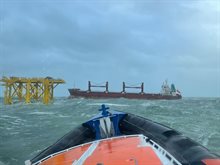
With the arrival of new wind farms, the risk of collisions with wind turbines from passing vessels or drifting objects is increasing. The fact that the damage caused can be extensive was shown by the accident with the Julietta D in 2022. This cargo vessel collided with the foundations of a wind turbine and a transformer platform: the damage ran into the millions. Rijkswaterstaat wants to prevent collisions wherever possible. So we are looking into how the risk of collisions can be reduced, what the causes are and how to limit damage.
The research topic of Collisions covers three sub-issues:
- Vessel/turbine collisions
- Vessel/vessel collisions
- Human factors
'Vessel/turbine collisions' relates to collisions between vessels and wind turbines. 'Vessel/vessel collisions' relates to collisions between individual vessels (in the vicinity of wind farms). 'Human factors', thirdly, investigates the influence of people on shipping safety: what sort of choices do people make in stressful situations? Are they properly aware of hazards in the surrounding area, and what role do linguistic or cultural differences play?
Research into vessel/turbine collision
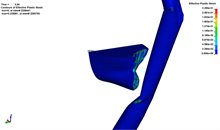
In 2020, exploratory research was carried out into the damage that occurs when a vessel collides with a wind turbine. In that way, knowledge could be gained about what happens in the event of collisions with wind turbines. Depending on the type of vessel and how the collision arises, the wind turbine may be undamaged, may buckle, break or even collapse. The impact of environmental factors on the damage, such as the wind, waves and vessel load, will be examined in greater depth in due course. A follow-up study was completed at the beginning of 2024, examining the possible consequences of collision with offshore wind turbines by validating the 2D modeling of failure modes of wind turbines and their foundations and the effect of various detail parameters. These parameters include the ground model, the impact direction of the ship relative to the rotor axis of the turbine, the effects of wind, waves, currents and loads through the turbine on the foundation, the effect of the propulsion load on the ship (due to wind , waves and currents in the case of a floating ship, or by the ship's engine in the case of a sailing ship), and the failure criteria applicable to the foundation of the wind turbine, such as failure due to plastic deformation or failure due to of foldsKnowledge of the consequences of vessel/turbine collisions helps the professionals of MOSWOZ (Offshore Wind Energy Shipping Safety Monitoring and Research Programme) to provide safety recommendations and to improve the protocol for dealing with incidents. Consider, for instance, the possibility of a recommendation to ensure that there are suitable resources to tackle an oil spill. Or, alternatively, a recommendation to evacuate the outside cabins as soon as vessels are in danger of drifting into a wind farm.
Vessel/vessel and vessel/turbine collision bow-tie risk assessments
In 2022, two reports on the risks of collisions in the North Sea were published. The first of these, 'Geactualiseerde BowTie aanvaringen schepen' (Updated vessel/vessel and vessel/turbine collision bow-tie risk assessments), addresses collisions between vessels on the North Sea, not least in the vicinity of wind farms. BowTie Schip-Windturbine aanvaring op de Noordzee’ (Vessel/wind turbine collision bow-tie risk assessments), the second report, addresses the risks of vessel/wind turbine collisions. Both reports and BowTies were updated in 2024 based on monitoring, new knowledge within MOSWOZ, and other developments related to shipping and wind farms in the North Sea. The results can be found in the reports ‘Geactualiseerde BowTie Aanvaring Schepen (pdf, 3 MB)' and ‘BowTies Schip-Windturbine aanvaring op de Noordzee (pdf, 2.9 MB) ’.
Human factors simulation study
Rijkswaterstaat is also investigating the role of human factors in collision risk for MOSWOZ. Just as on the road, people at sea sometimes have to make choices in stressful situations. For example, how does a helmsman react to another ship coming dangerously close? A wrong choice can then lead to a collision.
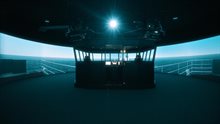
To gain more insight into these ‘human factors’, Intergo and Simwave conducted an exploratory simulation study in 2024. During this study, professionals practiced stressful situations in a virtual environment near wind farms in a future North Sea – when there are more wind farms and larger ships.
The MOSWOZ theme leaders had drawn up the scenarios (pdf, 5 MB) for the exercises based on relevant research questions. The simulation study (pdf, 18 MB) (management summaries in Dutch (pdf, 4.4 MB) and English (pdf, 5.1 MB)) answered multiple research questions per scenario and yielded valuable insights into how people at sea process information and make decisions. This allows us to determine whether additional measures are necessary and, if so, how these can be implemented. However, the exploratory nature of this study calls for a cautious treatment of the conclusions. More extensive research is required for a quantitative substantiation of the conclusions.